Stop Getting Played by Your Own Stadium: A Fan's Real Guide to Game-Day Value
Let's be upfront about something: going to a live game is one of the genuinely great experiences in American sports. The energy is real, the crowd noise is real, and no television broadcast has ever fully captured what it feels like to be in a packed stadium when something huge happens.
But the stadium experience has also become an increasingly sophisticated operation designed to separate you from your money at every possible touchpoint. From the moment you start planning the trip to the moment you drag yourself back to your car, there are about fifteen different hands in your pocket. Some of those hands are offering you something worth paying for. Most of them aren't.
Here's how to tell the difference.
Parking: The First Scam of the Day
Official stadium parking is almost always the worst deal available to you. You're paying a premium for the convenience of a lot that's going to trap you in traffic for 45 minutes after the final whistle anyway.
The move — and this is not a secret, but it bears repeating — is to park off-site and walk or rideshare the last stretch. Most stadiums sit in neighborhoods with private lots, church parking, and residential streets that charge a fraction of the official rate. Apps like SpotHero and ParkWhiz let you reserve these spots in advance, so you're not circling on game day. Budget an extra 15 minutes of walking time, and you've just saved yourself anywhere from $20 to $60 depending on the market.
If you're driving a group, the math gets even more favorable. Split a $25 private lot spot four ways and you're paying less than the cost of a stadium hot dog per person just to park.
Seats: Location Is a Spectrum, Not a Binary
The idea that you need to be close to the field to have a good experience is something stadiums very much want you to believe, because it's how they sell the expensive seats. The reality is more nuanced.
Lower bowl, sideline: You're paying for status as much as sightlines. The view of the play developing downfield is actually worse than you'd get from the upper deck. Good for atmosphere, not great for watching football.
Club level: The real value proposition here isn't the seat — it's the indoor access. Climate-controlled concourses, shorter concession lines, and actual restaurant-style food options. In markets with extreme weather (Green Bay in January, Miami in August), that indoor access is genuinely worth the upcharge.
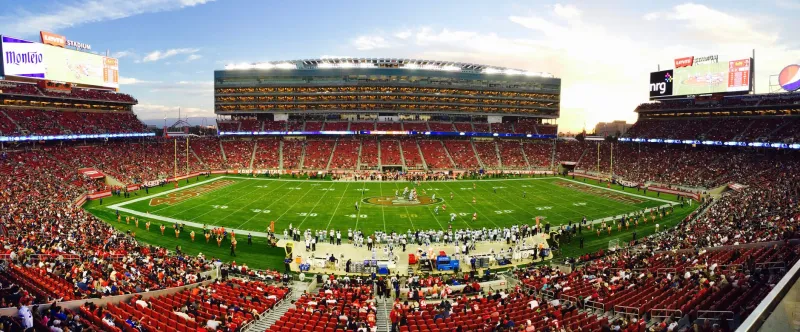
Upper deck, between the 20s: Criminally underrated. You get the full panoramic view of the game, you can actually see routes developing and coverage schemes, and you're paying maybe 30% of what the club seats cost. Bring binoculars if you want to track individual players, and you're set.
End zone seats: Cheap for a reason, but not without merit. For a high-scoring game or a team with a strong running attack, end zone seats give you a perspective you genuinely can't get anywhere else. Just know what you're signing up for.
Concessions: Pick Your Battles
This is where stadiums make an almost embarrassing amount of money off fan loyalty. The markup on stadium food and drink is not a secret, and yet every game day, millions of fans pay it without a second thought because they're hungry and it's right there.
A few practical approaches:
Eat before you go. This sounds obvious, but it's the single most effective cost-saving move available. A solid meal in the parking lot or at a nearby restaurant before you walk through the gates eliminates the desperation spending that happens when you're starving by the second quarter.
Know your venue's outside food policy. Many stadiums allow sealed water bottles and certain sealed snacks. Check before you go. The team's official website will have the bag policy listed, and it's worth five minutes of reading to save yourself $6 on a water bottle.
If you're going to buy inside, go early or go late. Lines at concession stands are worst during the first quarter and at halftime. The stands near the back of the concourse typically have shorter waits than the ones directly behind the main seating sections.
The beer math: Two stadium beers at most NFL venues will cost you $30 or more. That's just the reality. Budget for it or don't drink. What you shouldn't do is act surprised when you get to the register.
Stadium Tours: Genuinely Worth It or Tourist Trap?
This depends entirely on how you engage with sports history.
For a fan who's been following a franchise for decades, a proper stadium tour — the kind that takes you into the press box, the locker room, and behind the scenes — is legitimately compelling. You're seeing the physical spaces where the history you've watched actually happened. That's not nothing.
For a casual fan or someone bringing kids who are more interested in the game than the institution, a stadium tour is probably not the best use of your time or money. The pregame atmosphere outside the stadium in the hours before kickoff is free, and it's often more energetic than anything a guided tour provides.
Luxury Suites: The Honest Assessment
If you're paying for a suite out of pocket, it's almost certainly not worth it for a pure sports experience. You're behind glass, you're removed from the crowd energy that makes live sports compelling, and you're spending most of your time at the food spread rather than watching the game.
Where suites make sense: corporate entertainment, large group outings where the private space is the point, or weather conditions that make indoor viewing the only comfortable option. If the purpose of the outing is the game itself, a suite is the wrong call.
The Non-Negotiable Splurges
Not everything at the stadium is overpriced theater. A few things are genuinely worth paying for:
- A good seat upgrade for a marquee game. If this is a once-a-season trip to see a rivalry game or a playoff matchup, spending more on a better location is a reasonable decision. Context matters.
- The team store, selectively. Buying gear at the game has an emotional charge that ordering online doesn't replicate. If there's a specific item you've been wanting, buying it in the stadium on game day is an experience. Just don't impulse-buy three things you wouldn't have purchased otherwise.
- Pregame tailgate culture. The parking lot scene before a big game is often as memorable as the game itself. If your venue has a strong tailgate tradition, building time into your day to participate in it — even if you parked off-site and walked over — is worth it.
The Bottom Line
The stadium wants you to spend money at every step. That's not cynical — it's just business. Your job as a fan is to decide in advance which parts of the experience you actually value and spend accordingly, rather than reacting to every upsell opportunity in the moment.
The game is the point. Everything else is optional.